
Dental

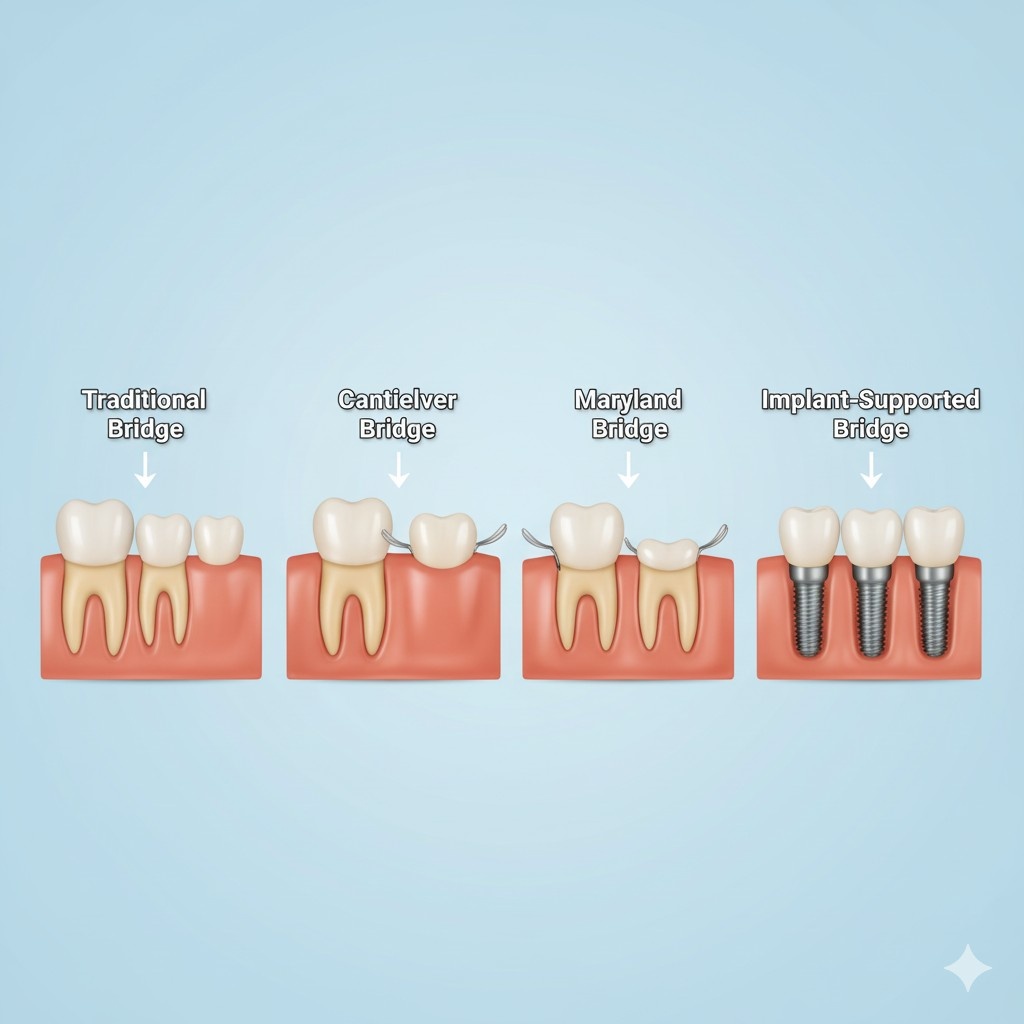
Types of Dental Bridges: Traditional, Cantilever, Maryland, and Implant-Supported

Missing teeth can impact more than just your smile—they can affect your speech, ability to chew, and even your confidence. Fortunately, dental bridges offer a reliable and long-lasting solution to restore your smile and oral health. But did you know there’s more than one type of dental bridge?

At The Dental Place, we believe in educating our patients so they can make informed decisions about their dental care. In this blog, we’ll break down the four main types of dental bridgesTraditional, Cantilever, Maryland, and Implant-Supported—including how they work, their benefits, and when each is recommended.

What Is a Dental Bridge?

A dental bridge is a fixed (non-removable) prosthetic that “bridges” the gap created by one or more missing teeth. It consists of one or more artificial teeth (called pontics) anchored in place by abutment teeth on either side of the gap.

Dental bridges help:

  • Restore your ability to chew and speak
  • Maintain the shape of your face
  • Prevent remaining teeth from shifting
  • Improve the appearance of your smile

Let’s explore the different types of bridges and which one may be best for your needs.

  1. Traditional Dental Bridge

Best for: Patients with natural teeth on both sides of the missing tooth

A traditional dental bridge is the most common type. It involves placing crowns on two healthy teeth adjacent to the missing tooth, which serve as anchors. A false tooth (or teeth) is then suspended between them.

How it works:
  • The dentist reshapes the two adjacent teeth
  • Crowns are placed on these abutment teeth
  • The pontic is fused between the crowns to complete the bridge
Pros:
  • Strong and durable
  • Ideal for replacing one or more teeth in a row
  • A well-established and proven method
Cons:
  • Requires removal of enamel from healthy teeth
  • May not be suitable if adjacent teeth are weak or already damaged
  1. Cantilever Dental Bridge

Best for: Patients who only have natural teeth on one side of the missing tooth

A cantilever bridge is similar to a traditional bridge but only uses one tooth as the anchor. It’s used when only one adjacent tooth is available to support the bridge.

How it works:
  • A crown is placed on one abutment tooth
  • The pontic is attached to the single crown
Pros:
  • Requires fewer teeth for support
  • Useful in specific cases where a second anchor tooth isn’t available
Cons:
  • Less stable than traditional bridges
  • Not ideal for areas that take a lot of bite pressure (like molars)
  • Higher risk of damage to the abutment tooth over time
  1. Maryland Dental Bridge (Resin-Bonded Bridge)

Best for: Replacing front teeth or when minimal alteration is desired

The Maryland bridge, also known as a resin-bonded bridge, is a more conservative option that doesn’t require reshaping adjacent teeth.

How it works:
  • A pontic is supported by a metal or porcelain framework
  • The framework is bonded to the back of the adjacent teeth using resin
Pros:
  • Minimal damage to surrounding teeth
  • Aesthetic option for front teeth
  • Less invasive than traditional bridges
Cons:
  • Less durable—may not withstand heavy chewing
  • Can debond more easily than other types
  • Not suitable for areas of high bite force
  1. Implant-Supported Dental Bridge

Best for: Patients missing multiple teeth and seeking a long-term solution

An implant-supported bridge is anchored to dental implants instead of natural teeth. Dental implants are titanium posts surgically placed into the jawbone, serving as artificial roots.

How it works:
  • Implants are placed in the jaw
  • After healing, the bridge is attached to the implants
Pros:
  • Does not rely on natural teeth for support
  • Extremely stable and secure
  • Preserves jawbone and facial structure
  • Long-lasting—can last decades with proper care
Cons:
  • Requires surgery and longer treatment time
  • Higher initial cost
  • Not suitable for patients with inadequate bone density (without grafting)

Which Dental Bridge Is Right for You?

Choosing the right type of dental bridge depends on several factors, including:

  • The location of the missing tooth
  • The condition of the surrounding teeth
  • Your budget
  • Your long-term oral health goals

At The Dental Place, our experienced dental team will carefully evaluate your needs and walk you through your options. We use the latest dental technologies and materials to ensure your bridge looks natural, feels comfortable, and lasts for years.

Restore Your Smile with Confidence

Missing teeth don’t have to be permanent—and you don’t have to live with discomfort or embarrassment. With a custom dental bridge from The Dental Place, you can restore function, boost your confidence, and enjoy the beauty of a complete smile.

Ready to take the next step?

📞 Contact The Dental Place today to schedule your consultation and find out which dental bridge is right for you.

Let’s rebuild your smile—beautifully and confidently.

Dental

Fixing Gaps, Chips, and Discoloration with Dental Veneers

If you’ve ever hidden your smile in photos or covered your mouth when laughing, you’re not alone. Small imperfections like gaps between teeth, chips, or stubborn discoloration can have a big impact on your confidence. Fortunately, modern dentistry offers a fast, natural-looking solution: dental veneers.

At The Dental Place, we specialize in cosmetic dentistry that transforms not just your teeth—but your self-esteem. One of our most popular treatments for a complete smile makeover is dental veneers, and for good reason. They’re durable, minimally invasive, and can dramatically improve the appearance of your smile in just a few visits.

What Are Dental Veneers?

Dental veneers are ultra-thin shells, usually made of porcelain or composite resin, that are bonded to the front surfaces of your teeth. They are custom-designed to match the shape, size, and color of your natural teeth—resulting in a seamless, beautiful smile.

Veneers are an excellent choice for addressing cosmetic concerns, especially when teeth are:

  • Chipped or cracked
  • Discolored or stained
  • Gapped or slightly misaligned
  • Uneven or irregular in shape

Let’s take a closer look at how veneers can help fix these specific issues.

  1. Closing Gaps Between Teeth

While some people embrace their natural gaps, others feel self-conscious about them. Small to moderate gaps—especially between the front teeth—can be easily corrected with veneers.

Instead of going through months or years of orthodontic treatment, veneers provide an almost immediate fix. Each veneer is carefully crafted to be slightly wider, closing the space while still looking completely natural. The result? A straighter, more uniform smile without the need for braces.

  1. Repairing Chipped or Worn Teeth

Chipped teeth can happen from an accident, grinding your teeth, or biting into something hard. Over time, wear and tear can also lead to uneven or short teeth.

Veneers cover the damaged areas, restoring the natural look and function of your teeth. Porcelain veneers, in particular, are strong and durable, able to withstand normal biting and chewing just like your natural enamel. They not only protect the tooth underneath but also restore your confidence when you smile.

  1. Hiding Discoloration and Stubborn Stains

Some types of discoloration don’t respond well to traditional whitening treatments—especially stains caused by medication, trauma, or enamel defects. In these cases, veneers offer a long-lasting solution.

Each veneer is color-matched to your ideal shade of white, instantly covering stains and creating a brighter, more youthful appearance. Because porcelain resists staining better than natural enamel, your smile stays whiter longer.

The Dental Veneer Process at The Dental Place

Here at The Dental Place, we make the veneer process smooth and stress-free. Here’s what to expect:

  1. Consultation and Smile Design

Your journey begins with a thorough consultation. We’ll discuss your concerns, goals, and evaluate whether veneers are the right option for you. Using digital imaging, we’ll even show you a preview of your future smile.

  1. Tooth Preparation

To make room for the veneers, a small amount of enamel is removed—typically less than a millimeter. Don’t worry, it’s a gentle and virtually painless process.

  1. Custom Veneer Creation

We take impressions of your teeth, which are sent to a dental lab where your custom veneers are crafted. If needed, temporary veneers may be placed while you wait.

  1. Final Placement

Once your veneers are ready, we carefully bond them to your teeth and make any final adjustments. You walk out with a transformed smile that looks completely natural.

Are Veneers Right for You?

Dental veneers are a great choice for many patients, but they may not be ideal if you have significant bite issues or untreated decay. During your consultation at The Dental Place, we’ll examine your oral health to ensure veneers are the best option—or suggest other treatments that fit your needs.

Care and Maintenance

With proper care, dental veneers can last 10–15 years or longer. Good oral hygiene, regular checkups, and avoiding habits like nail biting or using your teeth as tools will help protect your new smile.

Ready to Love Your Smile Again?

If you’re ready to say goodbye to gaps, chips, or stains, veneers could be your perfect solution. At The Dental Place, we’re passionate about helping you look and feel your best. Schedule a consultation today and take the first step toward the smile you’ve always wanted.

Your perfect smile is just a few visits away. Let’s make it happen.